
SEO vs Paid Ads in Australia: Which One Is Right for Your Business Right Now?
If you’re comparing SEO vs paid ads in Australia, you’re probably trying to make a smart investment decision.
Most business owners start with the question: “Should I invest in SEO or Google Ads?”
The thing here it’s that’s not actually a strategic decision, instead it’s a timing and intent decision.
Because both channels work, they just solve very different problems.
In the majority of the cases, businesses are pulled in two directions at the same time.
They need immediate leads, consistent cash flow, and fast feedback on what works. At the same time, they also want sustainable growth, lower cost per acquisition over time, and less reliance on paid traffic.
So they end up stuck between two options:
Google Ads → immediate results, ongoing cost
SEO (organic search) → slower to build, long-term payoff
And that tension is real, and it becomes much easier once they understand what each channel is actually designed to do and how to insert them in the strategy that makes most sense for their business right now.
So, let’s simplify this properly.

Road sign with arrows pointing to opposite directions
Paid Ads (e.g. Google Ads)
Also known as SEM (search engine marketing), it’s when you activelly pay the platforms to advertise your product. You gain:
Immediate visibility
Fast traffic and lead generation
You pay for every click
Performance stops the moment you stop spending
And does it work? Yes, the platforms also wants to make their share of profit so paid ads work immediately, but only as long as you keep funding them.
SEO (Organic Search)
Search Engine Optimisation is a group of activities you do to organically rank higher in the search engine platforms, so you naturally gain more exposition. Although it takes time to build, on SEO you’ll see:
No cost per click
Traffic compounds over time
Reduces reliance on paid acquisition
SEO becomes more cost-efficient over time and builds a long-term asset.
In summary, here’s what the data consistently shows:
SEO delivers stronger long-term ROI
Paid ads generate faster short-term results
Organic search drives the majority of clicks
Businesses using both channels outperform those using only one
In other words, paid ads buy speed, SEO builds leverage.
So… which one should you choose?
Wrong question. The right question is: What do you need right now?
A simple decision framework (to avoid the guesswork)
1. If you need leads immediately → Lean into Paid Ads
Use Google Ads when:
your pipeline is empty or inconsistent
you need enquiries in the next 30 days
you’re launching a new service or offer
This is your short-term demand driver.
But be clear about the trade-off: You are renting attention.
2. If you want sustainable growth → Invest in SEO
SEO makes sense when:
you want consistent inbound traffic
you’re thinking 3–12 months ahead
you want to reduce reliance on ads
This is your long-term growth engine.
And importantly: SEO doesn’t just drive traffic, instead, it compounds into higher engagement, trust, and revenue over time.
3. If you want to build properly → Use both (but staged)
This is where most high-performing businesses land. A practical approach looks like:
start with paid ads → generate immediate demand
build SEO in parallel → create long-term stability
gradually reduce dependency on paid
Businesses that combine SEO and paid ads consistently outperform single-channel strategies.
There’s even evidence that paid campaigns can strengthen organic performance over time.
The biggest mistake SMEs make is to try to choose one, usually due to money restrictions, which leads to two common traps:
relying only on ads → gets expensive fast
relying only on SEO → too slow to support cash flow
Both create pressure. Neither is strategic.
What about budget split?
There’s no universal formula. Anyone giving you a fixed percentage is guessing. But there is a pattern that shows up consistently on data:
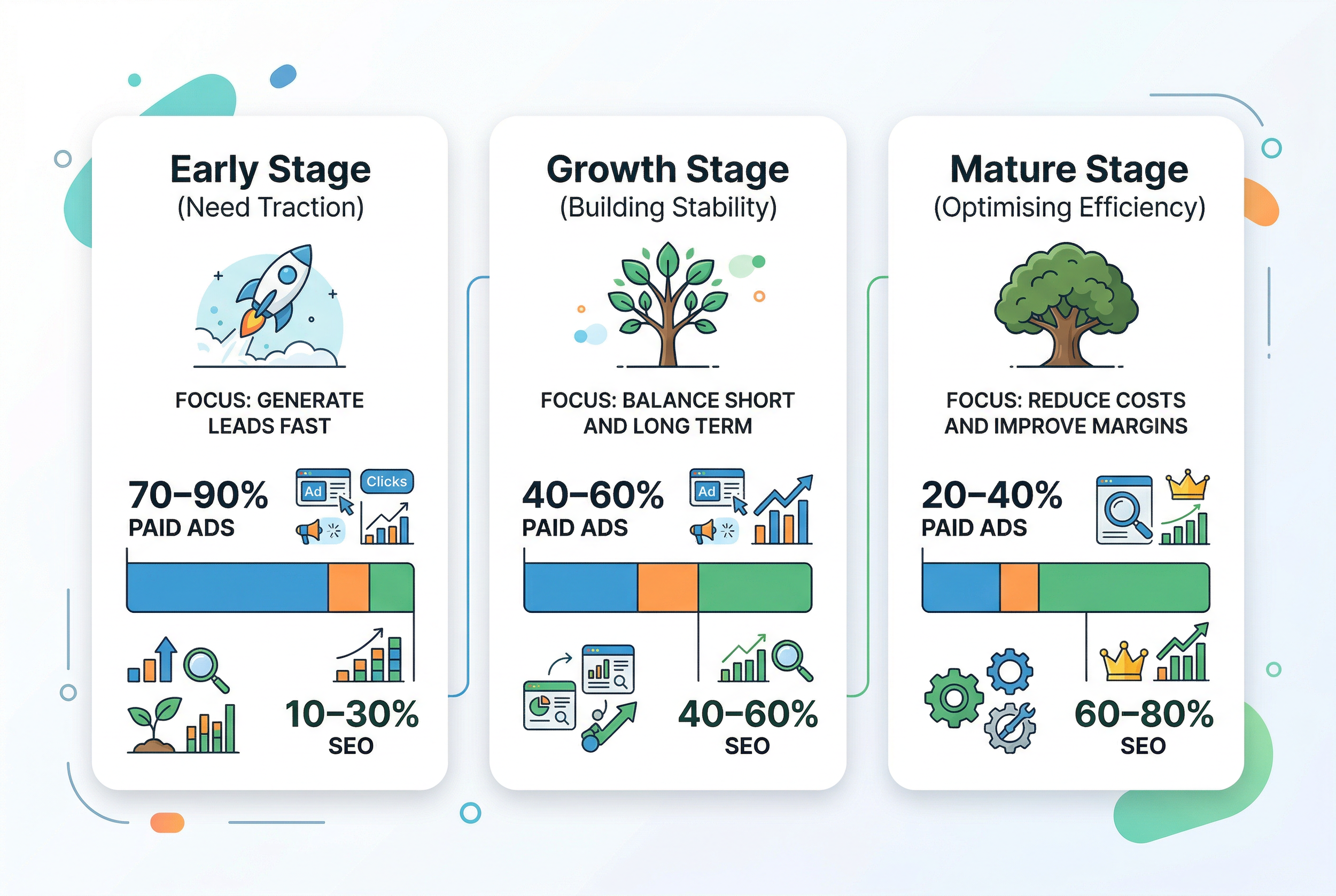
SEO vs paid ads Australia budget split by business stage showing early, growth and mature allocation percentages
This is a helpful guide to give you an idea of how marketing investment naturally evolves when decisions are based on performance.
A quick reality check most people ignore
SEO is not “free.” It does requires, time, content, and expertise
And paid ads are not “expensive” if they generate profitable customers, and bring scale predictably.
The issue isn’t cost. It’s whether your investment is intentional.
How to decide what YOU should do
Take a moment to reflect on these:
Do I need leads in the next 30 days?
Can I afford to wait 3–6 months for results?
Do I already know my best-performing offer?
If:
you need speed → lean into paid ads
you need sustainability → invest in SEO
you want both → stage your approach
What the data shows
There’s a clear pattern across research:
SEO drives stronger long-term ROI and reduces dependency on paid channels
Paid ads generate immediate traffic but require continuous investment
Organic search captures the majority of clicks
SEO improves engagement, conversions, and revenue over time
Businesses combining both channels outperform those using only one
You don’t choose between SEO and paid ads. You decide when to use each.
SEO builds the engine, and paid ads press the accelerator.
And the businesses that grow consistently aren’t choosing one over the other, they’re sequencing both, intentionally.
If you’re ready to grow but unsure on the best option for your business, book your free Advisory Session here. Let’s have a chat and discuss what the next steps for your business look like.